Expect their late husband or wife to stay part of their life, expect good days and bad days around anniversaries, and judge the relationship on how they treat you now, not on whether they still love the person who died. This page is for the new partner. If you are the one who was widowed, widowed and dating again in the UK is written for you. Someone widowed in their fifties, sixties or seventies may have been married for decades. That marriage does not disappear because they have met you, and it does not need to. Nobody is asking you to take anyone’s place. Your feelings count too, and feeling second best covers what you can fairly ask for.
What to expect
Their late husband or wife will come up in conversation. You will hear “we always went to Cornwall” or “she did all the garden”, often in the middle of something else. That is often how people talk after a long marriage. They are remembering out loud, and most of the time it has nothing to do with you.
There will be photos in the house, and the wedding picture may stay on the wall. There may still be clothes in the wardrobe, or a chair that nobody else sits in. Some people keep wearing their wedding ring for a long time. Those things are theirs to change, when they are ready. If one thing really troubles you, such as sleeping in the bed they shared, say so about that one thing and let them decide what to do.
Anniversaries are often harder than ordinary days. The date of the death, the wedding anniversary, the late partner’s birthday and Christmas can each bring a bad week, and so can Mothering Sunday or Father’s Day if they have children. Your partner may go quiet that week. On the day itself they may want to be with the family, or at the grave or the garden of remembrance. Ask ahead: “Would you like company that day, or would you rather be with the family?” Either answer is fine.
Expect some loyalty to the person who died, too, from their children and the rest of the family. Some will welcome you at once and others will take time. That is about their loss, not about you.
Cruse Bereavement Support, the bereavement charity, tells widowed people that “it's healthy to continue to remember with fondness the person who has died.” On the same page, love after loss, it adds: “It is possible to do this whilst learning to love someone new.” The page is written for the person who was widowed, but it is worth reading from your side too.
So it is not a competition, and you do not have to measure yourself against a memory. The person who died had their years with your partner, and you are there for the ones still to come.
How do you know a widow or widower is ready?
Cruse suggests some signs that a widowed person is ready to date, including “no longer feeling overwhelmed by grief, feeling capable of living life on your own”. Only your partner can judge that. What you can do is notice how they treat you, because whether someone is serious about you shows in ordinary things more than in what they say.
Start with plans. If they book a theatre trip for the spring, or ask where you will both be at Christmas, that is a good sign. Grief can shrink the calendar to one day at a time, so plans for later in the year mean they are looking ahead again, with you in the picture.
Meeting their friends and family comes more slowly, and not all at once. But someone who is serious will usually let their friends, and at least some of their family, know that you exist.
Listen to who the conversation is about. The person who died belongs in it, and so do you. A partner who asks about your week, and remembers what you said, is making room for you.
Room in the house and the diary counts too. A drawer for your things, or a regular evening that is yours, says you are expected.
Being ready is not all or nothing, and someone can be ready and still cry on the anniversary. Cruse’s advice to them is “It helps to take things slowly and check how it feels at each stage.” It also tells them “It's OK to change your mind.” So if your partner steps back after a few dates, that may be what is happening. It is not a verdict on you, and you can give them room and see.
Feeling second best
Second best is how it can feel when one of their old friends calls you by the late partner’s name, or when every holiday idea turns out to be somewhere they went together. The feeling is common, and it is not petty. It is worth saying out loud before it hardens into resentment.
You can reasonably ask for some time that is yours: a holiday somewhere new, say, or a restaurant that is yours rather than theirs. You can ask not to be compared, even kindly. “He’d have fixed that straight away” is a comparison, and so is “she never liked Spain either”. And it is fair to be introduced by your name, as their partner, and to have a say in the home if you move in together.
What is not yours to ask is that they stop grieving, or put a date on when they will. The same goes for clearing away every photo or giving up the visits to the grave. Saying that one particular thing troubles you is still fair. Still loving the person who died need not put you second. That love belongs to a different part of their life.
When you raise it, pick a quiet moment, not the week of an anniversary. Talk about one thing that happened and how it felt, and leave the person who died out of it. “I felt a bit invisible at lunch on Sunday” is easier to hear than “you’re still in love with her”. Then ask what they think would help. If nothing changes after a long time, and every talk ends where it started, take that seriously. It may simply mean they are not ready yet, and asking for less will not fix that. WidowGuide has a longer page on dating a widower and feeling second best.
Red flags when dating a widow or widower
Most of what you meet is likely to be ordinary grief. The patterns worth taking seriously are the ones that leave no room for you, and anything to do with money.
Secrecy is the plainest case. Grown-up children can be told gently, and friends more easily still. If you are hidden from the family long after it would be natural to meet them, that can mean the person is not ready, or does not see a future with you.
A conversation that always turns to the late partner, and never to you, is the same problem in words. Talking about them is normal, but a partner who never asks about your life is not yet really in a relationship with you.
Speed can be a warning too. If they want you living their old life unchanged, very fast, down to your coat on the late partner’s hook, they may be filling a gap rather than getting to know you.
Money is a different kind of flag, because it may mean you are not dealing with a widow or widower at all. One version of romance fraud uses a profile that leads with a sad story about a late wife or husband. The messages are warm and constant, and weeks later there is a request for money. Age UK’s advice on dating in later life lists the signs. Watch out, it says, for people who “avoid video calls or meeting in person” or “want to move your conversation onto a different platform too quickly”. The same list includes people who “message you intensively, overwhelm you with affection, and even declare love very early on”, and people who “ask you for money”. It also says: “Never send money or financial information about yourself to someone you don't know well or haven't met.”
A real widower may well mention his late wife on his profile. The difference is that someone genuine does not ask a person they have never met for money. If you met on SilverSingles, bear in mind what the site does not check. SilverSingles states it does not conduct background checks on members. A sad story on a profile is only as true as the person telling it. If someone asks you for money, stop replying. The site’s FAQ says to “report the member from their profile or your conversation with them”. The signs of romance fraud, and where to report it in the UK, are on the safety page.
Adult children and the rest of the family
Your partner’s children may be grown up with children of their own, and they lost a mother or father too. Cruse, writing about how children react when a widowed parent meets someone new, says: “They might be worried, feel abandoned or confused.” It also says: “It's quite usual for people close to us to have views on whether we should form a new romantic relationship”.
Give them time. The first meeting may be stiff and the second easier. Meet on neutral ground, such as a pub lunch or a walk. The family home can wait, because every room there holds memories of the parent they lost. Avoid days that already mean a lot, like Christmas or a birthday, for that first meeting.
Let your partner lead, since they know their children. Do not try to win them over with presents, and do not act like a step-parent. Friendly, and a little in the background, is easier on everyone.
Do not push for approval. You do not need it to have a good relationship with your partner, and asking for it puts them in the middle. Some worries are practical, about the family home or money. Those conversations belong to your partner and their children.
The late partner’s family and old friends are part of this too. They may keep inviting your partner on their own for a while, and it is best to let them. Some will come round sooner than you expect, and some never quite will.
Looking after yourself too
Keep your own friends and routines, the choir night and the coffee with friends included. It is easy to fold your life into theirs, especially if theirs is the busier household. You will be better company for it, and you will have somewhere to take your feelings.
You may be widowed or divorced yourself, and dating again after a long gap. Their grief can stir up yours, and that is allowed. Dating after 60 in the UK covers where people meet and what to say in a first message.
If their grief, or yours, becomes too much, Cruse runs a helpline. The number is 0808 808 1677, and calls are free from all UK landlines and mobiles. It is open Monday, Wednesday, Thursday and Friday 9.30am to 5pm, Tuesday 1pm to 8pm, closed at weekends. The helpline is for anyone in the UK affected by grief, so you do not have to be the widowed one to ring. Ringing it about someone else’s loss is not disloyal. If either of you ever feels unable to cope at all, Samaritans can be reached on 116 123.
And if, after a long time, you are still unhappy, you are allowed to end it. Leaving a relationship that is not working is not cruelty to someone who is grieving.
We read the Cruse and Age UK pages quoted here on 28 September 2026. Opening hours can change, so check the Cruse site before you ring.
Questions people ask
Can a widower truly love again?
How long do most widowers wait before dating?
Is it normal for him or her to talk about their late partner?
What are the red flags when dating a widower?
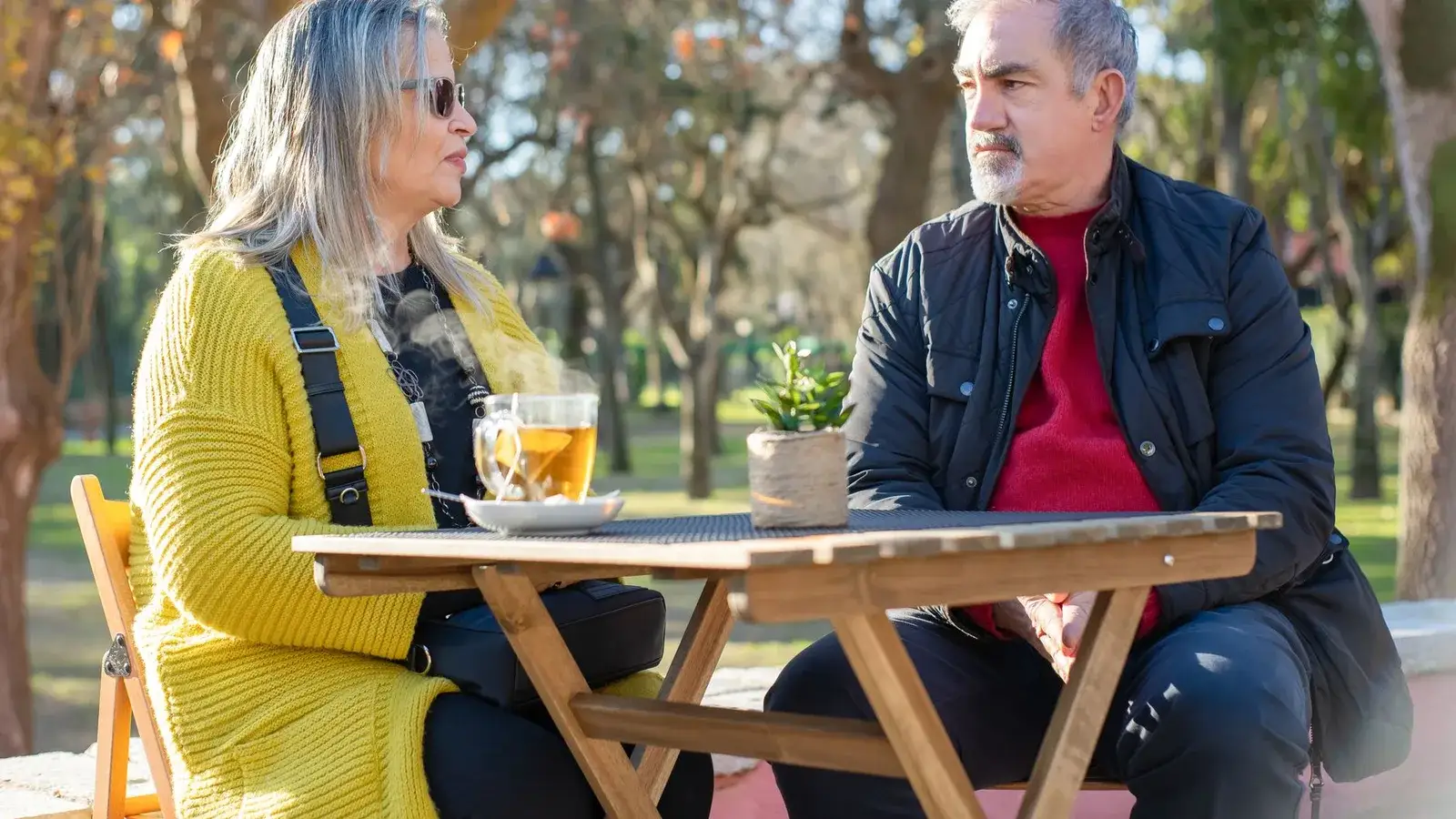
Photo: Kampus Production / Pexels. Illustrative, not a member.
Last updated 28 September 2026.